Louisiana law describes the inland edge of its Coastal Zone the way a surveyor would. The line runs north along the Tangipahoa/St. Tammany Parish boundary to Interstate 12, then follows I-12 east for a long stretch until it reaches I-10 and continues to the Mississippi line.
"thence easterly along the southern right-of-way of I-12 a distance of approximately 172,968 feet to the southern right-of-way of Interstate Highway 10 (I-10)"
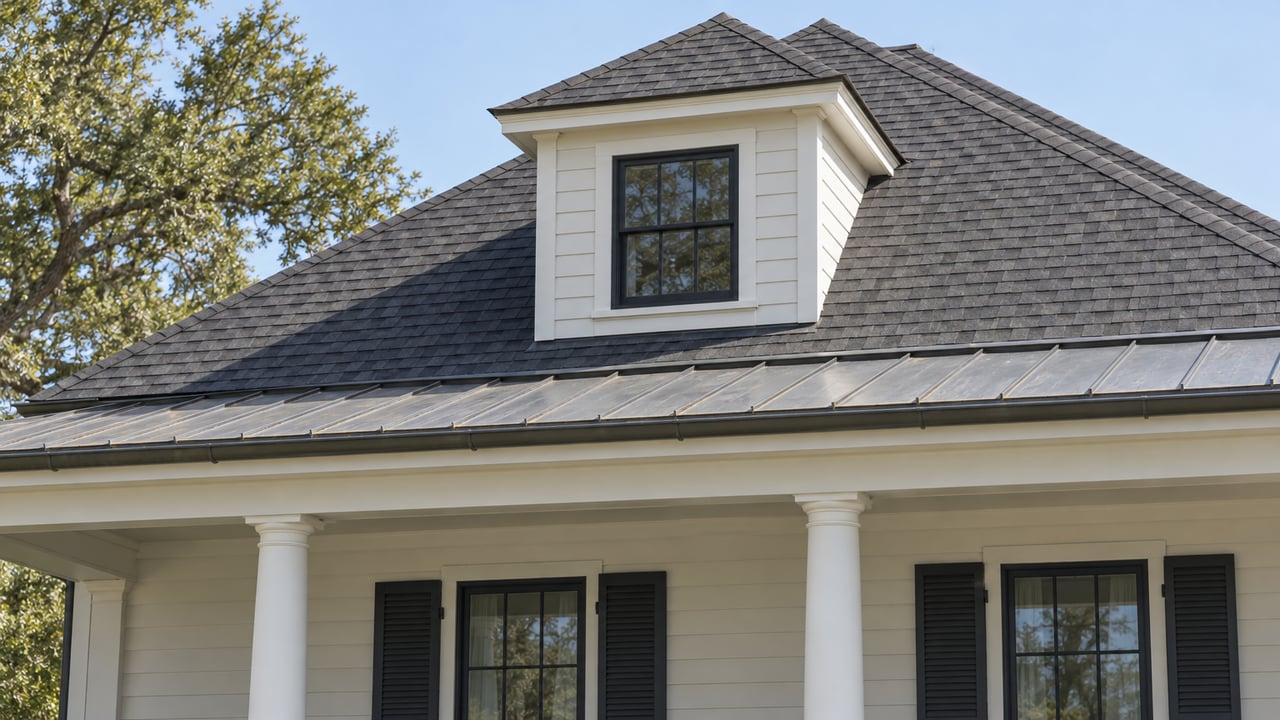
That line was written for coastal management. It also ended up shaping who on the Northshore could get state help paying for a hurricane-resistant roof. Before this year, the Louisiana Fortify Homes Program was limited to the Coastal Zone, along with a few named cities in the Lake Charles area. In St. Tammany, that meant the interstate was the edge of eligibility, and the parts of the Covington area north of it sat outside.
A second map came out in 2026, and it does not follow I-12. It follows parish lines. That second map sets the insurance discount a FORTIFIED roof earns. Starting with the policy renewals coming up this winter, a certified roof in Covington will carry the same state benchmark discount as one on the Mandeville lakefront. As a result, the paper certificate behind the roof matters more in a sale than it used to, and so does the date printed on it.
The certificate transfers at sale, with its five-year expiration intact
Start with the transaction itself, because that is where buyers tend to be surprised. The Louisiana Department of Insurance says a FORTIFIED Roof certificate can pass to the new owner when a home sells. So the buyer inherits the designation, and the discount that comes with it, without having paid for the roof.
The buyer also inherits the designation's age. According to the Insurance Institute for Business & Home Safety, a first designation expires five years after it is issued and then needs a redesignation inspection. Renewal is generally possible if the roof covering is still in good shape and the home hasn't been substantially changed. The fees depend on timing. Renewals filed within a year after expiration carry no late fee. Renewals filed after that grace period but within five years cost $50. Once a designation has been expired for five years, the roof needs a full new evaluation.
For a Covington purchase, the certificate is a dated document, much like a termite letter or a survey. A four-year-old designation and a four-month-old one look the same in a listing remark. They are not equally useful to the person who will hold the policy next year. Sellers putting together their paperwork can think of the certificate the same way they think about the items covered in our guide to what goes in a seller's disclosure: it has the most value when its details are visible early.
Why a new owner can't get the grant before closing
The second piece of friction comes from how the grant program is built. To register for the Fortify Homes lottery, a homeowner uploads homestead exemption documents and insurance declarations, including wind coverage and, for homes in a flood zone, flood coverage. The Louisiana Illuminator reported that homeowners who need a copy of their homestead exemption are directed to their parish tax assessor.
Since registration depends on a homestead exemption, the grant is a tool for owners who already live in the home. A buyer under contract has no way to enter the lottery for the house they are buying. A buyer who closes can register for a later round, but a lottery has no guaranteed outcome. Homeowners also have to register again for each new round, even if they entered an earlier one and weren't picked.
So a roof that is already certified at the time of sale and a roof that might get certified someday are very different things in a contract. The contingency structure in a Louisiana purchase agreement is where that difference usually comes up, alongside insurance quotes.
The parish map that sets the discount
Until now, Louisiana law required admitted insurers to give an "actuarially justified" discount or credit for FORTIFIED construction without setting a percentage. The Department of Insurance said most insurers applied it to the wind-and-hail portion of the premium. As a result, discounts varied widely. In the department's carrier table, with filings current through July 1, 2026, State Farm's homeowners discounts ran from 19% to 39%, and Louisiana Citizens' discounts ran from 7.2% to 24.3% depending on zone.
Regulation 136 replaces that spread with benchmarks. LDI Bulletin 2026-04, dated April 29, 2026, directs insurers to apply the benchmark discounts to the hurricane portion of premium on new or renewed residential policies no later than January 1, 2027.
The zones come from catastrophe modeling. According to the methodology document published with the rule, the state was modeled ZIP code by ZIP code, and the final regions were then "defined by parish." All of St. Tammany is in the South region. Neighboring Washington Parish is in Central.
| Benchmark, hurricane portion of premium | FORTIFIED Roof | Silver | Gold |
|---|---|---|---|
| South, including all of St. Tammany | 29% | 43% | 49% |
| Central, including Washington Parish | 27% | 35% | 42% |
| North | 16% | 20% | 24% |
I-12 makes no difference to the discount. A certified roof on a large lot north of town and one near the lake fall under the same South benchmark. Between parishes, the gap opens up above the Roof level. St. Tammany and Washington Parish are two points apart at Roof, eight at Silver, and seven at Gold. For buyers weighing acreage in Folsom against land across the line in Washington Parish, the parish line now shows up in the insurance math as well as on the deed.
What the money looks like in practice
The best public measure of real-world results is still the Louisiana Legislative Auditor's 2025 review of grant recipients. The Louisiana Illuminator reported a median premium reduction of 22%. In the example cited, an annual premium dropped from $5,625 to $4,375, a savings of $1,250. The same review found that homeowners often paid around $6,229 out of pocket even after the $10,000 grant.
Dividing one by the other gives a rough sense of the timeline. At that example's savings, the out-of-pocket cost takes about five years to recover, which is also how long the designation lasts before it needs redesignation. The figures come from a single example premium. A buyer taking over a newer designation gets more of that five-year window, with the upfront cost already paid by someone else.
Larger homes add another wrinkle. Grants are capped at $10,000 and limited to construction costs, so they may not cover a full upgrade, depending on the roof's size. Selected homeowners also pay for the FORTIFIED evaluation, permits, inspections, and any construction costs above the grant. On an estate-sized roof, the grant covers a smaller share of the job, while the benchmark discount still applies to the hurricane portion of the premium.
Where the programs stand this October
The June 1–19, 2026 lottery offered an estimated 3,000 grants. LDI said portions of St. Tammany that had been left out before were now eligible, but it did not name specific areas. House Bill 1187 added $50 million from a Louisiana Citizens surplus, which is expected to fund about 5,000 more grants. As of May 2026, the program had issued about 4,900 grants since it started in 2023, and another 8,300 fortified roofs had been installed without the state subsidy.
WAFB reported on September 22, 2026 that funding and location selection for the next round would start October 1, with the 5,000 grants expected before the end of the year. As of mid-October, the Fortify Homes page still shows registration as closed, with future rounds to be announced.
Homeowners who aren't selected can turn to the state tax credit created by Act 404 of 2025. According to the Louisiana Department of Revenue, the credit covers 100% of qualified expenses, up to $10,000 per residence. It applies to a primary residence that is not a condominium, mobile home, or new construction, and the claimant cannot have received a Fortify Homes grant. Credits are first-come, first-served, with a $10 million annual cap. Roofs certified in 2026 become eligible to apply starting January 1, 2027. The Louisiana Illuminator has described the credit as refundable and usable with or without a grant. The department's revenue bulletin calls it nonrefundable, with unused amounts carried forward for up to three years.
There is also a smaller local program. East St. Tammany Habitat for Humanity offers income-qualified grants of up to $15,000 for homes in the eastern part of the parish. NOLA.com relayed Habitat's claim that fortified homes may sell for up to 7% more. That figure comes without local sales data to back it, so it works better as a hypothesis for Covington than as a pricing rule.
Questions that come up during a sale
Does a FORTIFIED discount automatically continue for a buyer? The certificate can transfer at sale, according to LDI. The discount depends on the new owner's policy and on the designation still being current or renewable under the IBHS rules described above.
Is a Covington home north of I-12 eligible for a Fortify Homes grant now? LDI says some previously excluded portions of St. Tammany became eligible in 2026. It has not published a list of those areas by street or ZIP code, so eligibility is confirmed address by address through the program.
Do Silver and Gold matter in St. Tammany? In the South region, the benchmarks rise from 29% at the Roof level to 43% at Silver and 49% at Gold. Each of those applies to the hurricane portion of the premium.
If you're preparing a Covington home for sale with a FORTIFIED roof on it, the certificate, its issue date, and its renewal status are part of how that home should be priced and presented. Jennifer Rice and Lauren Mendheim can include that paperwork in a complimentary home valuation, so its value is clear before a buyer's insurance agent asks about it.
This article is general information, not legal, tax or financial advice. Consult a qualified professional about your situation.